Volume control with LDRs
This section introduces the Light Dependent Resistor (LDR), provides a brief tutorial on how volume control works generally, and how volume control with LDRs is similar yet uniquely different from conventional volume control technology.
What is an LDR?
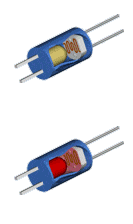
A light dependent resistor (LDR) is the marriage of a photoresistor with a light emitting diode (LED) in a small sealed package approximately the size of an M&M candy. Each LDR has 2 pairs of wires. One pair connects to the LED end while the second pair connect to the photoresistor end.
Inside the LDR, the LED shines light on the phtoresistor. The resistance of an LDR varies inversely in proportion to the brightness of the LED with brightness determined by the control current running through the LED. Increasing LED current increases the LED brightness which in turn reduces the the photoresistor resistance.
Through precise control of its LED current, LDRs can smoothly regulate resistance over a wide enough range to provide effective high performance audio volume control.
LDRs optically isolate the control circuitry from the audio signal passing through the photoresistor. The audio signal only encounters a variable resistance that is regulated by photons (i.e. light) and not electrons.
Tortuga Audio preamps utilize LDRs to control volume (i.e. to attenuate the audio signal).
Why LDRs for volume control?
We use LDRs because their subjective sound quality is amazing. Adjectives like clear, open, unveiled, organic, articulate, and uncolored all apply to the LDR. All while maintaining excellent bass and overall dynamics even in a passive preamp.
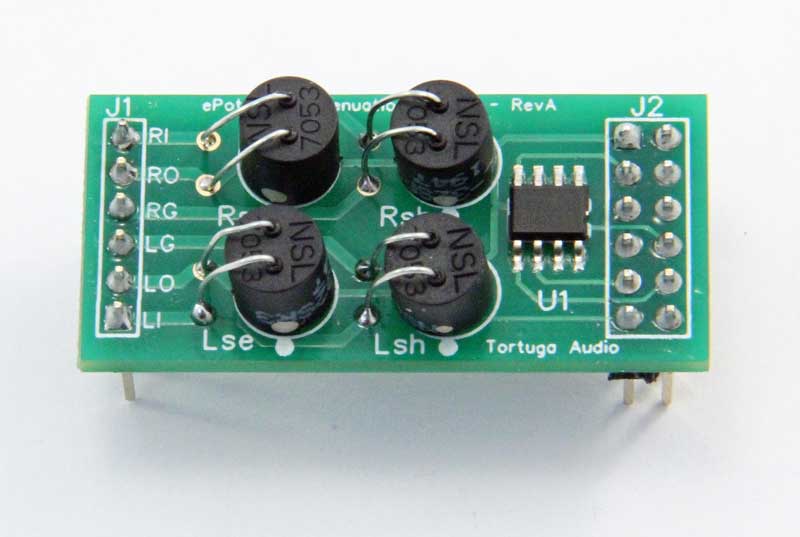
Figure 2. V3/V4 type module
|
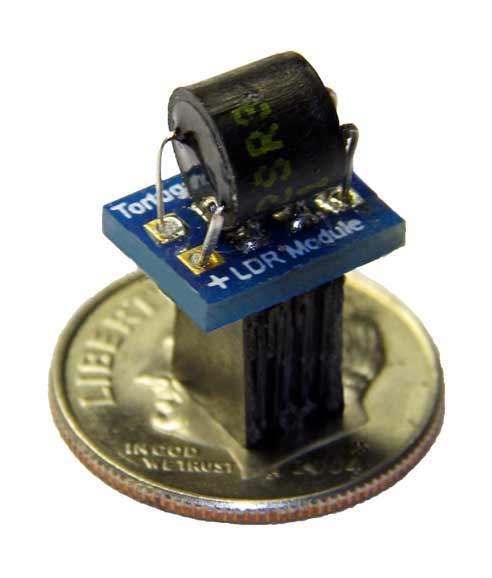
Figure 3. V2/V25 type module
|
If LDRs are so great why then why don’t all preamps use LDRs? A reasonable question with several answers.
First, LDRs are notoriously difficult to use for volume control. They are inherently nonlinear which means they are difficult to control accurately over the wide range of resistance needed for effective volume control.
Secondly, the performance curve of individual LDRs are not consistent even within the same make and model from the same production batch. Moreover, their performance curves may even drift slightly over time.
Last but not least, LDRs have higher distortion characteristics than most other alternatives although not enough that it really matters subjectively (the distortion is well below human detectable levels).
For all the above reasons most audio designers avoid taking on the challenge of using LDRs. That is not an irrational view.
Tortuga Audio took on this challenge over 15 years ago and has not looked back. We overcame these technical challenges. We are now on our 5th generation LDR preamp control technology.
Volume control is attenuation
When engineers talk about volume control they use the term "attenuation". Attenuation is the opposite of amplification. When you amplify an audio signal you are increasing its average voltage level. A higher voltage audio signal will be louder relative to a lower voltage signal. On the other hand, when you attenuate an audio signal you are reducing its average voltage level.
Attenuating an audio signal is typically done using a voltage divider. A potentiometer (a "pot") is the most common type of voltage divider. Almost every time you turn a volume control knob, you are turning a voltage divider pot. But not when you’re using a Tortuga Audio preamp!
How does volume control work
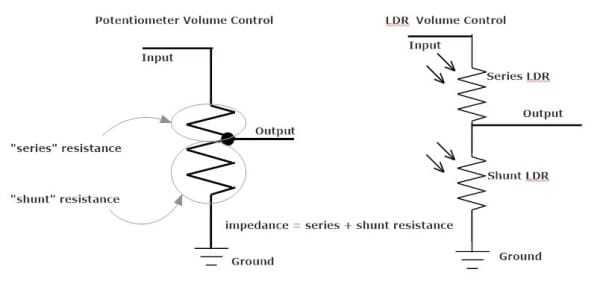
The figure above shows two different voltage dividers. On the left there’s a potentiometer and on the right is a pair of LDRs configured as a voltage divider. You’ll note there are obvious similarities between the two, at least schematically.
In both examples you have an Input signal feeding into a series resistor, followed by a shunt resitor connected to ground. The Output signal is the offtake point between the series and shunt resistors.
With a conventional potentiometer, the series and shunt resistors are a single continuous resistor material with a "wiper" output defining the split between the upper series resistance and the lower shunt resistance. As the user turns the shaft of the potentiometer, the wiper physically moves across the resistance material.
With an LDR voltage divider, the series and shunt resistors are in fact each a separate discrete LDR. The Output point is always between the two LDRs. Each LDR is controlled to achieve a specific resistance level.
The governing equations of most volume control are shown below
Let’s say you have an Rseries = 5k ohms and an Rshunt = 45k ohms. That yields an effective impedance of 50k ohms as seen by any device connected to the input of the attenuator. That gives us a ratio = 45 / ( 1 + 45) = 0.9. Plugging that into our attenuation formula we get dB = 20 x log (0.9) = -2.1 dB which would yield a modest level of attenuation that would be quite loud as a practical matter.
How do LDRs control volume?
Volume control with LDRs works basically the same as a potentiometer except that with LDRs the RSeries and RShunt resistance levels are controlled independent of each other. Once the LDRs are calibrated, a microcontroller controls each LDR to achieve the resistance ratios that correspond to the current target dB attenuation. While a pot does this mechanically, the resistance levels of both the series and shunt LDRs is done electronically with no mechanical wear parts.
Repeatable and reliable electronic control of LDRs is at the core of Tortuga Audio’s LDR volume control technology.