LDR1B.V25 Balanced Passive Preamp
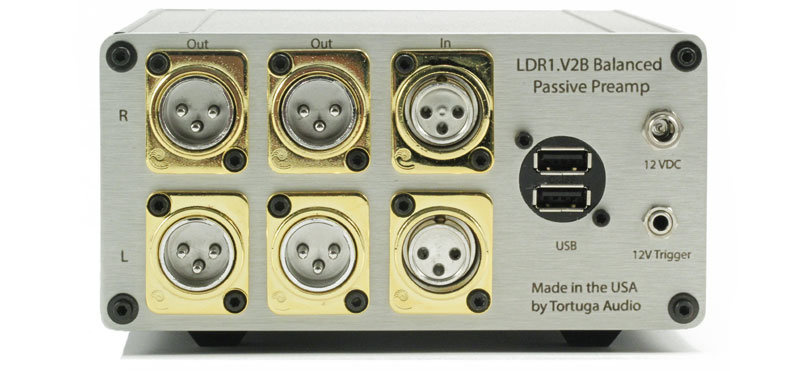
Price: $1,895
This is a legacy product and is no longer produced or sold by Tortuga Audio.
| This model was eventually superseded by the LDR3000P.V25 High Performance Passive Preamp. |
| A lower-cost LDR1B.V25K kit version of this preamp was also available, sonically identical but with an acrylic front panel and MilSpec hookup wire in place of the finished unit’s anodized aluminum panel and Neotech UP-OCC wire. |
A balanced passive preamp
The LDR1B.V25 Balanced Passive Preamplifier is a remote-controlled balanced audiophile grade passive preamp (attenuator) with 1 single XLR input and 2 parallel XLR outputs. The LDR1B provides true balanced attenuation with independent attenuation of both phases in each stereo channel. Being a true passive preamp, the LDR1B is a unity gain preamp with no amplification or buffering.
The LDR1B.V25 is an updated version of the earlier LDR1B.V2, closely paralleling the single-ended LDR3.V25. It incorporates the V25 preamp controller, which uses LDRs (Light Dependent photoResistors) for exceptional audio performance.
Enthusiasts who value a dead-quiet preamp with a deep dark background between the notes, exceptional transparency, and pleasing dynamics will find the LDR1B.V25 a very satisfying preamp rivaling many high-end preamps at a fraction of the cost, with a simple remote control for operation from the listening spot.
The LDR1B.V25 comes in black or silver anodized front panel finish, with high-quality Neutrik XLR jacks and Neotech OCC solid copper point-to-point hookup wire.
Subjective performance
Characteristics — colorless, transparent, neutral, articulate, clear, fuzz-free, clean, natural, high resolution, great mid-range, solid bass. These are words and phrases commonly used by both customers and reviewers to describe the sound.
Compared to other passive preamps — the consensus of customers and reviewers is performance superior to conventional passive preamps using even the best audiophile grade potentiometers, stepped resistive attenuators, or most transformer-based volume controls.
Compared to active preamps — independent reviewers have found that Tortuga’s passive preamps match the performance of high-end active preamps costing many thousands of dollars more.
Key features under the hood
-
True balanced attenuation — each phase of each channel is independently attenuated, with no conversion, conditioning, or processing of the audio signal beyond each signal phase passing through an L-Pad voltage divider composed of 2 LDRs in a classic series-shunt configuration.
-
Optically isolated passive attenuation — there’s no amplification or buffering of the audio signal notwithstanding the presence of a power supply used solely for photoresistor control and input switching. Audio signals are optically isolated from both the power supply and the LDR control circuitry.
-
4th generation LDR technology — built with the V25 preamp controller, which uses microprocessor-controlled analog LDRs to provide audio attenuation and input switching.
-
Built-in LDR calibration — self-contained calibration of the 4 attenuation LDRs maintains an accurate attenuation schedule and channel balance as the LDRs age.
-
Replaceable plug-in LDR modules — LDRs have an estimated useful life upwards of 50,000 hours, but like tubes, some may fail early or drift out of spec; our LDR modules are socketed and easily replaceable.
-
No relays in the signal path — LDRs are used for input switching in lieu of relays. Auto-calibration does employ relays, but these are physically disconnected from the audio signal path during normal operation.
-
Firmware updates via USB — firmware can be updated by the customer via a rear-panel USB port, downloaded from the Tortuga Audio website (V25 firmware updating) and uploaded from a PC (not currently compatible with Macs).
Key changes in the V25 model compared to V2
-
Overall smoother, quieter, more resolving attenuation — 100 vs. 70 steps
-
Major improvements to LDR control and auto-calibration
-
Faster, more powerful processor with expanded memory for future features/upgrades
-
Quieter power supply design with low-noise 2-stage DC-DC regulation
-
Input switching integrated into the main control board to minimize interface points
-
Provision for a future OLED graphical display and WiFi/control module
Specifications
Attenuation type |
Passive series/shunt (L-Pad) voltage divider using two (2) LDRs per channel — 4 attenuation LDRs for single-ended attenuation, 8 for balanced |
Attenuation range |
-60 dB to 0 dB in 99 steps of ~0.5 dB, plus 1 additional muting step |
LDR modules |
All LDRs are easily replaceable plug-in modules |
Gain |
Unity (1x) gain — no amplification, processing, or active manipulation of the audio signal; audio signal optically isolated from the control system |
Buffering |
No input or output stage buffering |
Auto calibration |
Built-in algorithm calibrates the four attenuation LDRs at each of the 99 attenuation steps to compensate for drift, aging, or LDR replacement. Pre-matched LDRs are not required; enables the adjustable impedance feature |
Adjustable impedance |
Nominal 20k by default; user may configure up to 9 additional impedance settings between 1k and 99k and switch between them with live music to optimize input impedance for their system |
Number of channels |
2 channel stereo |
Channel balance adjustment |
+/- 10 dB in 0.5 dB increments |
Channel balance accuracy |
Within 0.5 dB over the full attenuation range |
Channel isolation |
Each channel signal is 100% isolated and independent from the other; audio signal grounds are tied to a common star ground point |
Audio inputs |
1 Neutrik XLR input |
Input switching |
Via LDRs — typical 50 ohm resistance when on, in excess of 5 megaohms when off; no relays in the signal path; 6 LDRs used for input switching |
Output isolation |
Output signal is switched off and isolated during auto-calibration via LDRs (no relays in signal path); isolation in excess of 10 megaohms when switched off; 2 LDRs used for output isolation |
Total harmonic distortion |
1% or less |
Power supply |
US: nominal 12 VDC linear regulated "wall wart," 0.5 A. International: nominal 12 VDC switching "wall wart," 1.0 A |
Power regulation |
2-stage regulation — 5V first stage via low-noise switch-mode regulator, followed by 3.3V low-noise second-stage linear regulator |
Processor |
ARM M3 Cortex 32-bit microcontroller running at 72 MHz |
Controls — remote |
Silver Apple infrared remote or equivalent (38 kHz NEC protocol), received via infrared receiver module on the right display module |
Controls — encoder |
Rotary stepped encoder with integral push-button switch, attached to the right display module |
Control modes |
Volume & balance adjust (default); input adjust; impedance adjust; display adjust; max initial volume at input change; auto-calibration enable |
Display — current |
Dual 2-digit numerical 7-segment LED display with adjustable brightness |
Display — future |
Possible future upgrade to graphical OLED display at additional cost; would require a firmware update |
Mono mode |
Switch between stereo and mono via the remote (LDR switch) |
Firmware updates |
Via PC-based HID bootloader application (no Mac option); bootloader and firmware files downloadable from the company website (V25 firmware updating); firmware written in C, provided in hex format |
USB port |
Type A female, for firmware updates via the PC bootloader application; cable provided |
WiFi module (future) |
Plug-in module to allow smartphone app control; would require the module, a firmware update, and the future OLED display |
Trigger out |
Outputs 12 VDC when the unit is powered on, for use with other devices equipped with a trigger input |
Enclosure |
Heavy-wall extruded aluminum case with black powder coat finish; brushed anodized aluminum front and rear panel; dark grey acrylic inlay in front of the display; laser-etched rear panel labeling; black oxide socket screws; non-slip urethane feet |
Printed circuit board |
High-quality nickel immersion gold solder PCBs with blue solder mask |
Solder |
Lead-free solder with 3% or higher silver content |
RoHS |
Compliant or exempted |
Fuses |
No internal or external fuses |
Ambient requirements |
Must be operated in a stable, dry indoor environment with ambient temperature within 60-90 degrees F |
Dimensions |
~3.25" tall, ~6.0" wide, ~9.0" deep |
Weight |
~4 lbs; ~6 lbs as shipped |