LDR3000T.V25 Tube Preamp
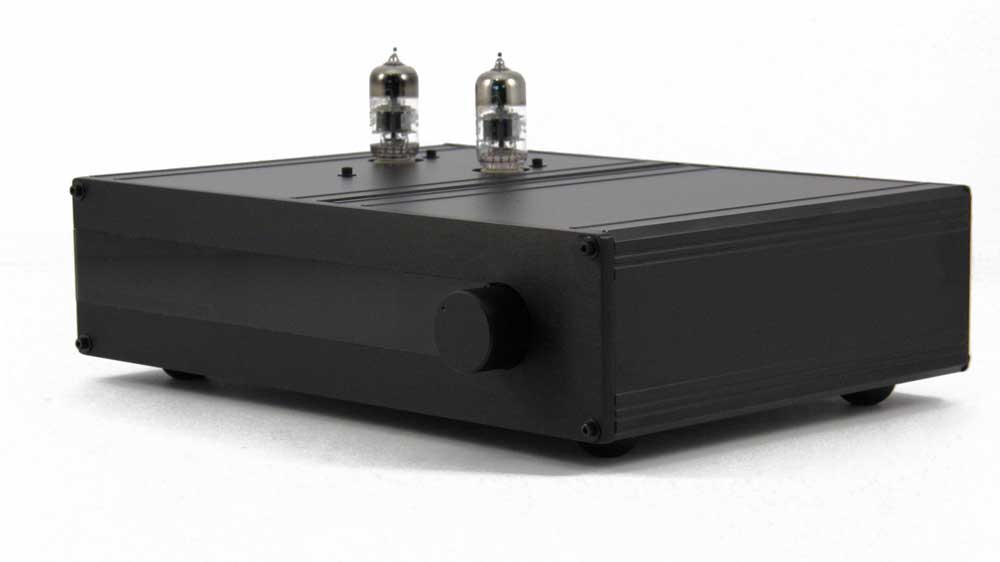
Price: $2,995
This is a legacy product and is no longer produced or sold by Tortuga Audio.
| The LDR3000T.V25 was eventually replaced by the LDR3000x.V3 High Performance Preamp, which offers an updated but similar tube configuration at a comparable price. |
-
Remote controlled tube preamp with 3 XLR & 3 RCA inputs
-
100-step LDR attenuator
-
Zero/low gain triode input/gain stage
-
Class A solid state JFET output stage/buffer
-
High resolution OLED visual display
Flexible single-ended & balanced tube preamp
Whether the source is RCA, XLR, or a mix of both, the LDR3000T handles it — there are 3 sets of RCA inputs and 3 sets of XLR inputs usable in any combination. The RCA and XLR outputs carry the same output signal regardless of source type, although the balanced output has only one phase active (pin #2) when the source is single-ended.
Elegantly simple signal path
The single greatest challenge for any preamp is remaining true to the source material while delivering the selected, attenuated audio signal to the amplifier honestly and without editorializing. The LDR3000T does this by combining Tortuga Audio’s LDR volume/preamp controller with a hybrid zero/low gain tube input/gain stage, followed by a simple yet highly effective solid-state JFET current amplifier (output buffer).
Most tube preamps and amplifiers run their tubes at high plate voltages and current to achieve high linear gain, but today’s sources, amps, and speakers need little to no preamp gain at all. Because of this, the LDR3000T runs its tube at a low "slack" voltage of only 45 volts instead of 250 or higher. At very low currents, many tubes will operate linearly even at such low voltage — with a compatible tube, the resulting zero/low gain sound quality is glorious.
This elegantly simple design keeps the signal path short and simple without compromising performance.
LDR volume control — V25
The LDR3000T is built around the 4th generation remote controlled V25 preamp controller, using digitally controlled analog LDRs to provide smooth 100-step volume control over a 60 dB range. Features include ramped muting, channel balance adjustment, input switching, both stereo and mono modes, and adjustable input impedance. Built-in calibration of the replaceable socketed LDRs ensures accurate attenuation, channel balance, and performance over the life of the preamp.
The LDR3000T is operated via an intuitive interactive menu driven control interface built around the 7-button Apple remote and a bright, easy-to-see 256x64 pixel white-on-black graphic OLED display.
Tube input/gain stage
The attenuated audio signal connects directly to the triode’s grid with no input coupling capacitor. The stock tube is the 9-pin 6H30Pi Gold triode from Electro-Harmonix, chosen for its reputation for sonic excellence, robust long life, and the fact that it’s a contemporary tube unlikely to go out of production for a long time.
While the 6H30 is a delightfully clean, neutral, yet smoothly muscular sounding tube with just the right amount of tube euphonics, the Genalex Gold Lion E88CC/6922 triode is offered as an alternative for a more lush sound. In fact, the LDR3000T is great for tube rolling most any tube in the 6922 family.
Tube rolling
Designing around the 6H30 tube means the LDR3000T has a very robust power supply, since the 6H30 demands high current. This opens up the possibility of trying a wide variety of alternative high-transconductance pin-compatible 9-pin triode tubes, including the 6DJ8, ECC88, E88CC, 6922, 6N23P, and 6N11, in both current and NOS versions.
A little gain, but only if you need it
The only reason for a preamp to have gain is if the amp can’t put out enough power to drive the speakers loud enough — rarely the case in the real world. Hence the LDR3000T’s default gain is set to unity (0 dB), but it can be adjusted up to +6 dB gain for systems that need more volume headroom. Adjusting the gain requires disassembly of the preamp and flipping around 4 plug-in gain resistor modules on the tube board.
Matched tubes — one for each stereo channel
Each stereo channel has its own dedicated triode tube for the best possible channel separation, sound stage, and stereo imaging. With single-ended audio, only half of each triode is used; with balanced audio, each triode handles both phases of its own stereo channel.
Solid state output stage
The output stage is a discrete solid-state current amplifier built around a contemporary version of the Toshiba 2SK170 JFET, operating in Class A mode with a constant current source. This discrete buffer delivers powerful, robust dynamics into practically any amplifier at a very low output impedance.
Robust power supply
The LDR3000T power supply starts with a robust linear supply built around a large 50 VA linear shielded toroidal transformer, an oversized bridge rectifier, and almost 38,000 uF of filter capacitance. This feeds 2 independent DC-DC switching regulators, one dedicated to the tube heaters. The second provides 48 volts into a second-stage linear regulator that supplies 45 volts to both the tube plate and the solid-state JFET output buffer — handling the current requirements of almost any 9-pin tube available.
High performance capacitor upgrade
The base price includes a modest yet high quality metalized polypropylene film output coupling capacitor. For the highest audiophile level, an upgrade was offered to either the VCAP ODAM (Oil Damped Advanced Metalized) or, for ultimate performance, the reference grade VCAP CuTF (Copper Foil Fluoropolymer Film) output coupling capacitor.
Specifications
These specifications reasonably reflect the final production model.
Category |
Criteria |
Description |
General |
Summary |
Remote controlled active tube preamplifier with 100-step LDR attenuator, zero/low gain slack voltage triode tube input/gain stage, and a Class A solid state JFET buffer output stage handling 3 inputs of any combination of single-ended (RCA) and balanced (XLR) sources. |
Audio Signals |
Inputs |
6 total: 3 single-ended RCA stereo inputs, 3 balanced XLR stereo inputs |
Outputs |
1 RCA stereo output, 1 balanced XLR stereo output |
|
Mixed signals |
Output from single-ended inputs is available on one phase only (pin 2) of the balanced output; only one phase (pin 2) of balanced inputs is available on the single-ended output |
|
Input coupling |
Direct coupled to the tube grid (no coupling capacitors) |
|
Output coupling |
AC coupled through coupling capacitors |
|
Input switching |
Via LDRs, with signal isolation in excess of 10 megaohms when off |
|
Output isolation |
Via a combination of LDRs and miniature relays |
|
Attenuation |
Technology |
Digitally controlled, optically isolated, analog LDRs in a series/shunt L-Pad voltage divider configuration |
Steps |
100 steps of ~0.6 dB per step, plus 1 additional muting step |
|
Range |
-60 dB to 0 dB |
|
Channels |
4 independent channels handling both 2-channel single-ended and 4-channel balanced signals, with 2 LDR modules per channel (8 attenuation LDRs total) |
|
Channel balance |
Left/right within 0.5 dB over the full attenuation range; /- 20 step channel balance adjustment at ~0.6 dB per step (~/- 12 dB max) |
|
LDR modules |
Each LDR is a compact, easily replaceable 4-pin socketed plug-in module. Not mechanically keyed, so alignment marks must be matched when removing/replacing |
|
LDR calibration |
Built-in software-driven closed-loop measurement circuit calibrates each attenuation step of each LDR over the full range. During calibration (~10 minutes) the preamp is offline and cannot play music |
|
Input/gain stage |
Type |
9-pin triode tube at slack voltage (45V); matched pair of Electro-Harmonix 6H30 Gold or Genalex Gold Lion E88CC/6922 triodes; tube-rolling friendly for the 6922 family |
Gain |
Default unity (0 dB); settable to +6 dB via a plug-in gain resistor module (requires disassembly, 4 modules) |
|
Output/buffer stage |
Type |
Discrete Class A fixed-current JFET current amplifier with AC output coupling |
Output capacitor |
Standard: metalized polypropylene film. Optional: VCAP ODAM or CuTF (additional cost) |
|
Isolation |
Output signals shunted to ground when powered down, muted, or during LDR calibration |
|
Impedance |
Input |
Default 20k ohms; up to 9 additional configurable settings between 1k and 99k |
Output |
Fixed at ~100 ohms |
|
Performance |
Total harmonic distortion |
Generally well below 0.5% under worst-case scenarios (not exhaustively measured) |
Power Supply |
Mains input |
IEC socket with lighted switch and fuse drawer, external 3A fuse plus spare |
Mains filter |
Oversized RFI/EMI filter/choke upstream of the transformer |
|
Type |
Classic linear supply followed by independent switching DC-DC/linear subsystems |
|
Transformer |
50 VA heavy duty shielded toroidal transformer |
|
Fusing |
2.5A internal fuse on transformer secondary; 3A external fuse in the IEC mains input module |
|
DC filtering |
Oversized bridge rectifier with 37,600 uF filtering |
|
Tube heater |
Dedicated high-efficiency, high-current DC-DC switching regulator, up to 2A at 6.3 VDC |
|
Tube plate & buffer |
Dedicated 2-stage regulated supply: DC-DC switching regulator with post-filtering, followed by a second-stage linear regulator |
|
Controls |
Controller |
V25 Preamp Controller Rev C — ARM M3 Cortex 32-bit microcontroller at 72 MHz |
Remote |
Silver 7-button Apple infrared remote (38 kHz NEC protocol) |
|
Encoder |
Front panel control knob on a rotary stepped encoder with integral push-button switch |
|
Display |
256x64 pixel white-on-black OLED, driven by an interactive menu-driven control interface |
|
Control menu |
Off (top menu item), Volume (default), Input, Display, Impedance/Cal, No. of Inputs, Volume Units, Volume Max, Volume Display, Version, Reset. Mono mode toggled by pressing the center button twice in a row |
|
Trigger out |
Rear panel mono phone jack, outputs 12 VDC when the unit is on |
|
USB port |
Rear panel dual Type A USB, for PC-based bootloader firmware updates (V25 firmware updating) |
|
Enclosure |
Case |
Heavy wall extruded aluminum case, black powder coat finish |
Front panel |
0.25" brushed anodized aluminum with dark grey acrylic inlay in front of the display |
|
Rear panel |
0.1" brushed anodized aluminum |
|
Feet |
Hudson Audio platinum silicone, non-skid, vibration-absorbing, 1" hemispherical (four) |
|
Other Design |
Printed circuit board |
High quality nickel immersion gold solder PCBs with blue solder mask |
Solder |
Lead-free solder with 3% or higher silver content |
|
RoHS |
Compliant or exempted |
|
Ambient criteria |
Stable, dry indoor environment only, ambient temperature within 60-90 degrees F |
|
Dimensions |
3.5" tall, 12.0" wide, 9.0" deep |